
Car History Report: Complete Guide to Buying Safe in Australia
Last Updated: January 08, 2026
Next Review: March 2026
Introduction
Buying a used car in Australia can be a smart financial move, but it comes with risks that can cost you thousands if you’re not careful. This guide is designed for used car buyers in Australia and covers everything you need to know about car history reports: what they are, why they matter, what’s included, how to get one, and how to use the information to protect yourself. Whether you’re buying from a private seller or a dealer, understanding car history checks is essential to avoid hidden problems like finance owing, write-offs, odometer fraud, or stolen vehicles. This guide explains everything you need to know about car history reports in Australia, including why they matter and how to get one.
Get Your Car History Check In 60 Seconds
Before you hand over any money, run a car history check to see if there’s any money still owing on the vehicle. If there is, the lender can legally take the car back later, even if you bought it in good faith.
- Why Car History Checks Matter
- What Is a Car History Check?
- What Does a Car History Report Include?
- Accident & Damage History
- Free vs Paid Comparison
- How to Check Car History
- Obtaining a Car History Check Certificate
- State-Based Car History
- How We Compare to Competitors
- Common Mistakes Buyers Make
- Frequently Asked Questions
- Conclusion & Final Advice
- Understanding the Personal Property Securities Register (PPSR)
- Finance Owing and Its Implications
- Car History and Insurance
- Dealer Sales and Car History
- Disclaimer
Why Car History Checks Matter
Real Buyer Stories
Sarah thought she’d found the perfect car. A 2018 Toyota Camry, silver, low kilometres, listed at $18,000 on Facebook Marketplace. The seller seemed genuine. She test drove it. Everything felt right. She handed over the cash.
Six months later, a tow truck arrived at her work. The bank was repossessing the car. Turns out the seller still owed $8,000 on it. The bank had a legal claim. Sarah lost her car and her $18,000. She had no way to get her money back.
Mike’s story was different, but just as painful. He bought an SUV for $22,000. It looked immaculate. What he didn’t know? It was a repairable write-off from a major accident three years earlier. The repairs were dodgy. Two months in, suspension issues appeared. The mechanic found hidden frame damage. Repair quote: $12,000. Mike couldn’t afford it.
Then there’s James. He paid $5,000 cash for a motorcycle from a private seller. Buying from private sellers carries extra risk, as they are not required to disclose issues like unpaid debts or previous damage. That’s why it’s crucial to independently verify the car’s history before handing over any money. Great deal, he thought. Three months later, police knocked on his door. The bike was stolen two years prior. Police seized it as evidence. James lost his $5,000 and faced weeks of legal headaches proving he didn’t know it was stolen.
Lisa’s problem was sneakier. She bought a car advertised at 80,000 kilometres for $14,000. Seemed reasonable for a 2017 model. But when she checked the service records later, she noticed something odd. The car had been serviced at 145,000 kilometres just 18 months earlier. The odometer had been wound back. The car had been thrashed. Within six months, she faced more than $6,000 in premature repairs and maintenance.
Key Risks of Not Checking
Here’s the thing. These stories aren’t rare. They happen every single week across Australia. In NSW alone, odometer fraud complaints went from 242 in 2022 to 503 in 2023. That’s double. And those are just the ones reported.
Every one of these problems could have been caught by carefully reviewing the car’s history before purchase. A $7.90 report would have shown Sarah the finance owing. Mike would have seen the write-off status. James would have discovered the stolen vehicle flag. Lisa would have spotted the odometer discrepancy. They’d all still have their money.
This guide shows you how to avoid becoming the next statistic. What to check, when to check it, and what red flags mean you should walk away. Because buying a used car shouldn’t feel like gambling.
What Is a Car History Check?
A car history check reveals whether a used car has been stolen, written off, or has financial interests attached to it.
How a Car History Check Works
A car history check is a report that shows if there’s a problem with a used car's history. Pretty simple concept, actually. It checks four main things: if someone owes money on the car, if it’s been stolen, if it’s badly damaged, and what maintenance has been done.
Think of it like a background check, but for cars instead of people. To request a vehicle history report, you need to provide the car’s registration number or the car's Vehicle Identification Number (VIN). The VIN (Vehicle Identification Number) is a 17-character unique identifier for a vehicle, found on the car, usually on the dashboard or driver’s door frame. For some checks, you may also need the chassis number, which is another important identifier. Accurate details like the VIN and chassis number are crucial for a valid search and to obtain proper protection through certification. Once you enter these details, you get back a PDF with everything that’s officially recorded about that used vehicle. Takes about five minutes to run.
The big database behind most of this is called the PPSR. The PPSR (Personal Property Securities Register) in Australia checks for financial interests, stolen status, or write-offs. That’s the Personal Property Securities Register. The PPSR is a government database that shows if a bank or finance company has a claim on the car. If someone still owes money on it, that shows up here. This is the most important thing to check, because if there’s finance owing, the lender can legally repossess the car from you even after you’ve paid for it.
You can check a car's history through government agencies in some states, or purchase a check from a private provider.
Here’s what a proper car history report includes:
-
What it does: Checks if the car is safe to buy based on official records and the used car's history
-
Why it matters: Protects your money from hidden problems that could cost thousands
-
How it works: Enter the rego number or VIN, request an instant PDF report within minutes
-
What’s included: Finance check, stolen vehicle status, write-off history, safety recalls, odometer readings, registration validity, and the full history and reported history of the used vehicle, including accident, theft, and financial records
-
Cost: $7.90 for a comprehensive report
Most people don’t realise how much information is actually recorded about Australian cars. Every time a car changes hands, gets serviced at certain places, or has a major incident, that can go into government databases. A good car history check pulls all that together into one report you can actually understand. The information returned in the report depends on the data available in national databases.
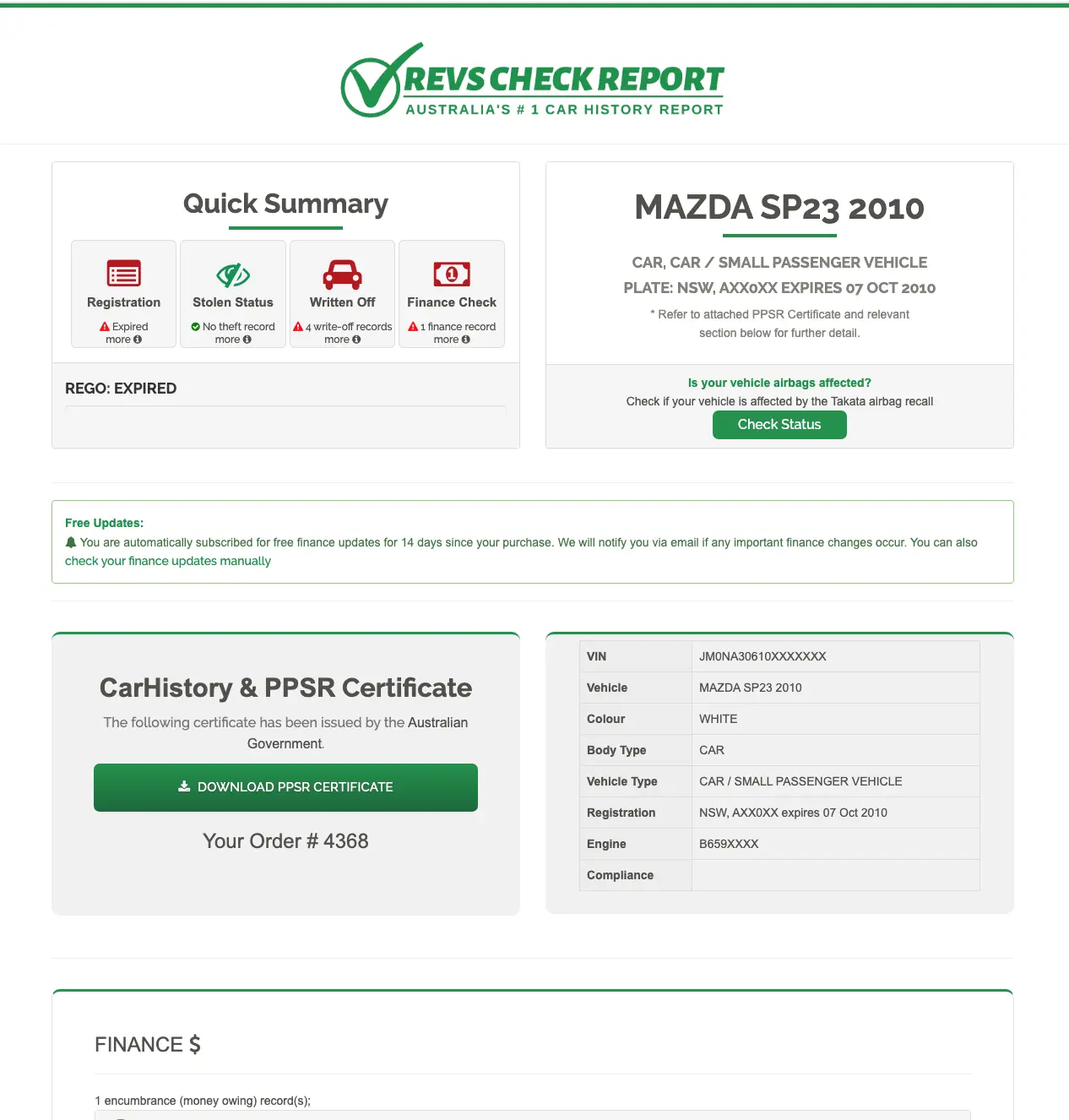
The alternative is trusting what the seller tells you. And let’s be honest, they’re not always going to mention the car’s been written off or still has money owing on it. Why would they? That’d kill the sale.
Get your car history report for $7.90. It’s less than the cost of a tank of petrol, but it could save you from losing the entire car. Our report includes PPSR certificate, stolen check, write-off status, and odometer history. Results show what’s officially recorded at the time. Always verify important details and get a mechanic inspection before purchasing.
Now that you understand what a car history check is and why it matters, let’s break down exactly what’s included in a comprehensive report.
What Does a Car History Report Include?
A comprehensive car history report should include a PPSR Certificate, Odometer History, Written-Off Status, Stolen Status, Recall Status, and Ownership & Title information.
Let’s break down exactly what you’re getting when you run a car history report on a used motor vehicle registered in Australia. No jargon, no marketing fluff. Just the facts about what’s in there and what’s not.
A car history report provides detailed information about the motor vehicle’s past, including:
-
Registration information: The report shows the current registration status and the registration expiry date for the motor vehicle.
-
Vehicle specifications: Details such as make, model, year, and VIN. The report can also help you compare the sales price to similar vehicles in the market.
-
Finance check: Identifies if there are any outstanding financial interests registered against the vehicle.
-
Accident and write-off history: A car history check can reveal if the vehicle has been involved in an accident or has outstanding financial interests.
-
Stolen status: Indicates if the vehicle is listed as stolen.
-
Odometer readings: Helps detect possible odometer tampering.
This information is essential for anyone considering the purchase of a used motor vehicle, as it helps you make an informed decision and avoid potential risks.
What's In The Report
-
Registration information: This shows who owns the car and if the registration is current. You’ll see the registration expiry date, when the rego expires, what state it’s registered in, and if there’s anything unusual about the registration history. If a car’s been registered in five different states in two years, that’s worth asking about.
-
Stolen status: The report confirms whether the car has been reported stolen to police. This checks against national stolen vehicle databases. If it comes back as stolen, don’t touch it. Walk away immediately. Police will seize it and you’ll lose everything.
-
Write-off status: This shows if the car was badly damaged at some point and an insurance company declared it a write-off. Some write-offs get repaired and sold again, which is legal. But you need to know about it because the repairs might not be up to scratch. More on this in the next section.
-
Safety recalls: Car manufacturers sometimes discover safety problems after cars are sold. They issue recalls to fix these for free. The report lists any outstanding recalls for that specific vehicle. If there are any, you can get them fixed at a dealer before you buy.
-
Finance owing: This is the big one. The report shows if a bank or finance company has a legal claim on the car. If there’s money owing and you buy the car, the lender can repossess it from you. You lose both the car and your money. This happens more often than you’d think.
-
Vehicle specifications: Basic details like engine type, colour, manufacturing year, and body type. This helps you confirm you’re looking at the right car and that the details match what the seller claims.
What It Doesn't Do
Here’s where you need to be realistic. A car history report is not a crystal ball. It shows what’s been officially recorded, not every single thing that’s ever happened to the car. The report is designed to alert buyers to potentially significant information that could affect their purchasing decision, helping you make a more informed choice based on the vehicle’s history.
For example, a report from June might be outdated by September. Finance status can change. Someone might take out a loan against the car after you checked it. That’s why smart buyers check twice: once before the deposit, and again on the day of purchase.
The report is not a mechanic inspection. It doesn’t check if the engine is about to blow, if the brakes are worn, or if the suspension is shot. You still need a proper mechanical inspection before you buy. These are two different things that both matter.
Some accidents never get recorded anywhere. If someone has a minor crash, fixes it privately, and doesn’t claim insurance, that won’t show up on any database. Not every repair is tracked. The report shows what’s in official systems, not what people kept quiet.
Here’s a real example of how different reports reveal different problems. Sarah’s report showed finance owing, so she walked away from that deal. Mike’s report showed a repairable write-off, which prompted him to get a mechanic inspection that found the dodgy repairs. Lisa’s report flagged odometer issues when the readings didn’t add up. Each person discovered something different, and each problem would have cost them thousands if they hadn’t checked.
Look, the report gives you the official record. That’s valuable. But it’s not the whole story. Use it as part of your due diligence, not instead of it. For more details on exactly what reports include, see our full breakdown.
Now that you know what’s in the report, let’s look at how accident and damage history is recorded.
Accident & Damage History
Can a car history check tell you if a car’s been in an accident? Sometimes. Not always. Here’s the honest truth: not all accidents are recorded in any database. But there’s still plenty you CAN check to reduce your risk.
If a car was damaged badly enough, the insurer—the insurance company—might declare it a write-off. That’s when the insurer decides the repair cost is too high compared to the car’s value. When that happens, it gets recorded. That WILL show up on a car history report.
But here’s where it gets tricky. Some write-offs get repaired and sold again. That’s completely legal in Australia. The car gets classified as a “repairable write-off,” someone fixes the damage, and it goes back on the road. The problem? You don’t know if those repairs were done properly or by a dodgy backyard operation.
Understanding Write-Offs
There are two main types of write-offs in Australia. Statutory write-offs are so badly damaged they can never be registered again. These can’t legally be driven on roads. If a report shows statutory write-off, walk away. End of story. This write-off status becomes part of the vehicle’s reported history, which is officially documented and included in comprehensive car history reports.
Repairable write-offs are different. The car was damaged, but not beyond repair. Someone fixed it. It can be re-registered and driven. But buyer beware - the quality of those repairs varies massively. Some are done professionally at proper body shops. Others are botched jobs that hide structural damage.
Red Flag Alert
Red flag: Your report shows "Repairable Write-Off"
What it means: The car was badly damaged at some point. Could be flood damage, fire damage, or a serious accident. Someone repaired it. But you can't tell from the report alone whether those repairs are any good.
What to do: Don't buy it unless you get a mechanic to inspect it first. This is non-negotiable. A proper pre-purchase inspection costs $200-300, and it's worth every cent. The mechanic will check if the repairs were done right or if there's hidden damage.
How To Reduce Your Risk
Even if the report comes back clean, you should still look for signs of accident damage when you inspect the car yourself. What happens if the accident was never reported to insurance? Or if it happened before the current recording systems existed? You need to look for physical clues.
Check the paint carefully. Is it all one colour? Or does it look patchy in some areas? If sections of the car are slightly different colours, that’s a sign of repainting, which usually means accident damage. Look at the car in good lighting, not at night.
Check how the body panels line up. Do the gaps between panels match on both sides? Are they even? If one side looks perfect but the other side has uneven gaps, someone’s replaced panels after an accident. Run your hand along the edges - can you feel where panels meet? They should be smooth.
Get under the car if you can. Look for welding marks or rust in unusual places. Fresh welding on structural parts means serious repair work. Rust around welded areas suggests the repair was done a while ago and might not have been done properly.
Finally, just book a mechanic inspection. Costs $200-300. Takes an hour. The mechanic knows what to look for that you’ll miss. They’ll check the structure, the alignment, evidence of previous damage. Money well spent.
For a more detailed guide on spotting accident damage, check out our page on accident history checks.
Check write-off status in your car history report for $7.90. Know before you buy if a car’s been declared damaged by insurance. Our report includes PPSR write-off status and damage history. Remember, the report shows official records only. Always get a mechanic inspection to check current condition.
For full protection, consider other checks as well—such as verifying the service history, confirming there are no outstanding debts, and arranging a professional inspection—alongside your car history report.
Next, let’s compare free and paid car history checks so you know what level of protection you’re getting.
Free vs Paid Comparison
You might be thinking, “Why should I pay $7.90 when there are free checks available?” Fair question. Let’s break down what you actually get with each option and where free checks fall short.
Some providers, such as Budget Direct, offer a free PPSR check for vehicle history. However, these free checks are usually limited in scope and may not include details like odometer history, market value, or comprehensive write-off data.
Reports from most providers are accessible for viewing and download through their website after purchase. This allows you to manage and review your car history report online for a set period.
|
Feature |
Free Rego Check |
PPSR Only ($2) |
Full Report ($7.90) |
Recall Check (Free) |
|---|---|---|---|---|
|
Finance owing |
No |
Yes |
Yes |
No |
|
Stolen status |
No |
Yes |
Yes |
No |
|
Write-off history |
No |
Yes |
Yes |
No |
|
Odometer history |
No |
No |
Yes |
No |
|
Safety recalls |
No |
No |
Yes |
Yes |
|
Rego status |
Basic |
No |
Full details |
No |
|
Market value estimate |
No |
No |
Yes |
No |
What Each Check Actually Shows
-
Finance owing: This is the #1 reason people lose cars after buying them. If someone still owes money on the car, the bank can repossess it from you legally. Free rego checks can't see this. You MUST check PPSR or get a full report. This alone justifies the cost.
-
Stolen status: Only PPSR and paid reports show if a car's been reported stolen. Free rego checks miss this completely. If you buy a stolen car, even unknowingly, police will seize it. You lose your money. No exceptions.
-
Write-off history: Free checks don't show if the car's been badly damaged. PPSR and full reports do. This matters because repairable write-offs need mechanic inspections. You need to know before you waste time viewing a car.
-
Odometer history: Remember Lisa from earlier? She lost $6,000+ because the odometer had been wound back. Free checks don't track this. Full reports do. They cross-reference readings from different sources to spot fraud.
State-Specific Free Tools (2025 Update)
Some states have recently added new free tools that are actually useful. NSW now has a free odometer reading tool. It shows the last three years of odometer readings for vehicles registered in NSW. That's genuinely helpful for spotting fraud. If you're buying in NSW, use this alongside your paid report.
Victoria's VicRoads offers a vehicle report for $29.95. It's not free, but it includes electronic roadworthy history, which shows when the car passed inspections. Useful if you're buying in Victoria and want extra detail about the car's condition history.
Other states? Pretty basic. Queensland has Transport and Main Roads rego check. WA has Department of Transport check. SA has EzyReg. They'll all show you rego expiry and status, but that's about it. They're fine for a quick check, but they're not enough on their own.
The Value Proposition
Here’s the reality. A free rego check gives you maybe 15% of the information you need. It tells you if the rego is current. That’s useful, but it misses all the big risks.
For $7.90, you get the complete picture. PPSR finance check, stolen status, write-off history, odometer analysis, recall information, registration details, and market value. The comprehensive report provides the full history of the vehicle, covering all major risk factors—accident, theft, and financial records—so you have an extensive overview of the car’s past. That’s everything you need to make an informed decision.
Think about it this way: you’re about to hand over $15,000 or $20,000 or more for a car. Spending $7.90 to check it’s not going to be repossessed or turn out to be stolen seems like pretty cheap insurance, doesn’t it?
Want to dive deeper into the free vs paid comparison? Or explore what free car history checks are actually available? We’ve got detailed guides for both.
Compare the full report to free options. Get your comprehensive car history report for $7.90. Includes everything free checks miss: finance owing, stolen status, write-off history, and odometer fraud detection. Report shows official records at time of check. Always verify critical details and inspect before purchase.
Next, let’s walk through the step-by-step process of checking a car’s history and obtaining your official certificate.
How to Check Car History
Right. You’ve found a car you like. What now? Here’s the exact workflow successful car buyers follow. Four phases, done in order, no shortcuts.
Step-by-Step Workflow
-
Gather the car’s details
-
You’ll need the Vehicle Identification Number (VIN), make, model, and year. The VIN can be found in several places: on the car itself (usually on the dashboard near the windscreen, or on the driver’s side door frame), in the owner’s manual, and on the car’s registration label. The car's registration label is a key spot for locating the VIN and other identifiers needed for your car history report.
-
-
Complete a PPSR check online
-
Go to a trusted provider and complete the online form to request a PPSR (Personal Property Securities Register) search certificate. The PPSR check can be completed online and usually takes about 10 minutes to receive the certificate. This certificate will show if there is any finance owing or if the car is listed as stolen or written-off.
-
-
Review the car history report
-
Carefully read the car history report and PPSR certificate. Look for any red flags, such as outstanding finance, previous write-off status, or discrepancies in the VIN or registration details.
-
-
Keep your documentation
-
Always keep the car history check certificate as proof that the vehicle was free of encumbrances at the time of purchase. This can protect you if issues arise later.
-
By following these steps, you reduce your risk and make a more informed decision.
Phase 1: Before You Visit The Car
Step 1: Get the rego number or VIN
Don't waste time driving across town to see a car that's going to fail basic checks. Do your research first from home.
If the seller won't provide this, that's a red flag right there. Legitimate sellers have nothing to hide. If they're being cagey about the rego number, walk away.
Step 2: Run a car history report online
Takes five minutes. Costs $7.90. You'll get an instant PDF showing finance status, write-off history, stolen status, and odometer readings.
Step 3: Actually read the report
Don't just skim it. Check every section. Look for red flags: finance owing, write-off status, odometer discrepancies, outstanding recalls.
Step 4: Make a decision
Is it safe to visit this car? Or should you walk away now before wasting your time? If the report shows finance owing or statutory write-off, don't bother going. Save yourself the trip.
Phase 2: When You Visit The Car
Step 5: Check that the VIN on the car matches your report
This is critical. VIN fraud exists. People swap plates or fake VINs to hide a car's real history. Where do you find the VIN? Check the windscreen (bottom corner), door jamb (sticker when you open driver's door), and sometimes on the engine block. All these VINs should match each other and match your report.
Step 6: Check the odometer reading
Does it match what's in your report? If your report says the last recorded reading was 120,000 km but the dashboard shows 85,000 km, something's very wrong. The odometer doesn't go backwards unless someone's tampered with it.
Step 7: Look at the service logbook
Do the dates and odometer readings line up with what's in your report? If the service book shows a service at 130,000 km last year but the odometer now shows 95,000 km, you've caught them in odometer fraud.
Step 8: Ask the seller about anything your report found
If it showed a repairable write-off, ask what happened. When? Where was it repaired? Can they show you paperwork? Their answer tells you a lot about whether they're being honest.
Phase 3: Before You Pay Any Deposit
Step 9: Book a mechanic inspection
This costs $200-300. The mechanic checks things the history report can’t: engine condition, brake wear, suspension, rust, evidence of hidden damage. This is especially important if the report showed a repairable write-off.
Step 10: Run a second car history check
Wait, didn’t you already do this? Yes. But finance status can change between viewings. Someone could take out a loan against the car after you first checked it. Check again on the day you’re planning to pay, before money changes hands. When reviewing the report, always verify that the chassis number, registration, and VIN on the car match the details in the report. Accurate vehicle details, including the chassis number, are crucial for a valid search and for your protection.
Step 11: Review the mechanic’s report
Any problems? If they found issues, use these to negotiate the price down or decide to walk away. Don’t ignore red flags because you’ve fallen in love with the car.
Step 12: Make your final decision
Based on both history checks and the mechanic inspection, is this car worth what they’re asking? Negotiate if needed. Or walk away if problems outweigh the value.
Phase 4: Before You Hand Over Final Payment
Step 13: If your report showed finance owing and the seller agreed to clear it before sale, get proof
You need a clearance letter from the finance company showing the debt is paid. Don't accept "I'll pay it after you pay me." That's how Sarah lost her car. Get proof before final payment.
Step 14: Do a final walk-through of the car
Has any new damage appeared since your last visit? Check the body, wheels, interior. Make sure you're buying the same car you inspected, not one that's picked up damage in the meantime.
Step 15: Complete the purchase and arrange registration transfer
Each state has different timelines for this. Usually you have 14 days to transfer rego into your name. Don't sleep on this - late fees apply.
Pro Tip: Check Twice
This is important enough to repeat. Run the car history check twice. Once before you visit the car. Once on the day of purchase, before final payment. Finance status can literally change overnight. What was clear last week might not be clear today. This one step could save you from Sarah's fate.
Need more detail on the checking process? See our guide on how to check car history. If you're specifically worried about finance, read our page on finance owing checks. Buying privately? Check out our private sale checklist.
Start the process by running your car history check now. Get instant access to PPSR finance check, write-off status, stolen vehicle check, and odometer history for $7.90. Check early, check often. Our report is point-in-time only. Always verify details and get professional inspections.
Now that you know the process, let’s look at how to obtain your official car history check certificate.
Obtaining a Car History Check Certificate
Getting a car history check certificate is straightforward and takes just minutes online. You'll need the vehicle's identification number (VIN) or registration details. Simply enter these into a reputable car history service—like the official PPSR or a licenced provider—and you'll receive a comprehensive report to protect yourself before buying.
Your certificate will reveal crucial information including any outstanding finance, accident and write-off history, previous owners, and more. Take time to review the certificate carefully, making sure the details match the car you're considering. Always check that the information is current as of the search date—this matters for your protection.
Make sure you're using a trusted provider for your car history check. This certificate becomes your official record of the vehicle's status when you searched, and it's valuable evidence if you ever need to prove you exercised proper care. Keep a copy for your records, and let it guide your decision-making before you finalise any purchase.
With your certificate in hand, let’s explore how car history checks work across different states in Australia.
State-Based Car History
Here’s something that confuses a lot of buyers: car history checks are partly national and partly state-based. This is especially important when buying a used vehicle, as these checks can reveal crucial information about the car’s background before you commit to a purchase. Some checks work the same everywhere in Australia. Others vary depending on which state you’re in or which state the car’s registered in.
Why does this matter? Because if you’re buying a used vehicle that’s registered interstate, you need to understand how checks work in both states - where the car is now, and where you’ll be registering it.
National Checks (Same Everywhere)
Some databases cover all of Australia. These work regardless of which state you're buying in.
PPSR: This is national. Doesn't matter if the car's registered in NSW, Victoria, Queensland, or anywhere else. The PPSR database shows finance owing, stolen status, and write-off history for vehicles across Australia. You run it once, it checks everything, regardless of state.
Safety recalls: Also national. If Toyota issues a recall for a safety issue, that recall applies to every affected Toyota in Australia, not just specific states. The government recall database covers the whole country.
State-Specific Checks (Different In Each State)
Registration systems are run by state governments, not the federal government. That means each state has its own way of checking registration details.
NSW: Service NSW handles registration. They have online rego checks showing expiry date and status. As of 2025, NSW also has that free odometer reading tool showing the last three years of readings.
Victoria: VicRoads manages registration. They have a vehicle report system that includes electronic roadworthy history. This shows when the car passed safety checks, which can tell you something about its condition over time.
Queensland: Transport and Main Roads runs the rego system. Different online portal, different layout, but similar basic information.
Western Australia: Department of Transport WA has their own system. Transfer timelines are slightly different too.
South Australia: Uses the EzyReg system. Again, different portal, same basic function.
Tasmania, ACT, NT: Each has their own setup with their own quirks.
Why This Matters When Buying Interstate
Let's say you're in Melbourne and you find a great car in Sydney. It's registered in NSW. You'll need to check NSW registration details to see its current status. But you'll also need to understand Victoria's requirements for transferring interstate rego. The requirements and timelines vary.
The PPSR check will work regardless - that's national. But the state-specific rego checks and transfer processes are different between NSW and VIC.
Keep It Simple
Look, you don't need to become an expert in every state's registration system. That's what our state-specific guides are for. If you're buying in a particular state, just check the guide for that state.
For most buyers, here's what you actually need to do: Run the national checks (PPSR and recalls) regardless of where you're buying. Then check the registration status in whichever state the car is currently registered. That covers your bases.
Want detailed information for your specific state? See our complete guide to checks by state. Or jump straight to your state: NSW car history checks, Queensland car history checks, Victoria car history checks, Western Australia checks, or South Australia checks.
Next, let’s see how our service compares to other car history check providers.
How We Compare to Competitors
You’ve probably noticed there are multiple car history check services in Australia. So why choose one over another? Let’s be honest about what actually makes a difference.
|
What to Compare |
RevscheckReport |
Other Services |
|---|---|---|
|
Price transparency |
$7.90 shown upfront |
Varies, sometimes hidden |
|
What’s included |
PPSR, write-offs, stolen, odometer, recalls |
Usually similar PPSR data |
|
Educational content |
Comprehensive guides for every scenario |
Usually just transactional |
|
State-specific guidance |
Dedicated guides for NSW, VIC, QLD, WA, SA |
Generic national content |
|
Honest about limitations |
We explain what reports can’t show |
Rarely mentioned |
|
Website access |
Reports and account management available through our website |
Most services provide reports and account access via their website, with varying durations for online report availability |
What Actually Matters
Here’s something most car history services won’t tell you: we all pull from the same PPSR database. That’s the government database with finance and write-off information. The information returned in your car history report is based on what is available from these official government databases. We’re all accessing the same core data. The difference isn’t what data we have access to – it’s how we present it and what else we provide.
Price: We charge $7.90. That’s 80% cheaper than some competitors who charge $30-40 for essentially the same PPSR data. Why pay more for the same information?
Education: Most services just want to sell you a report and move on. We’ve built comprehensive guides explaining what everything means. You’re reading one right now. This pillar page, our state guides, our topic-specific pages – these exist to help you make informed decisions, not just process transactions.
State expertise: We have dedicated guides for each major state. Not generic content that sort of applies everywhere, but specific information for NSW buyers, Victoria buyers, Queensland buyers. Because the requirements and systems differ.
Honesty about limitations: We explain what car history reports can’t do. We tell you upfront that reports show official records only, that some accidents aren’t recorded, that you still need a mechanic inspection. Building trust means being honest about limitations.
Australian focus: We write for Australian buyers about Australian systems. Not American salvage titles or Canadian systems that don’t apply here. PPSR, VicRoads, Service NSW, repairable write-offs – Australian terminology for Australian buyers.
The Bottom Line
All legitimate car history report services pull from the same government databases. The difference is clarity, education, and price. You can pay $40 elsewhere for the same PPSR data. Or you can pay $7.90 here and get the same data plus actual guidance on what to do with it.
Want to see detailed comparisons? Check out our page on the best car history services or learn more about what reports include regardless of provider.
See why Revs Check Report is the smart choice for Australian car buyers. Same PPSR data as expensive competitors. 80% cheaper. Educational guides included. Get your comprehensive report for $7.90. Remember, all reports show official records only. Always verify important details and get professional inspections.
Next, let’s review the most common mistakes buyers make—and how to avoid them.
Common Mistakes Buyers Make
Skipping the Check
-
Skipping the check entirely: James thought he'd save $7.90 and just trust the seller. The bloke seemed honest. Why would he lie? Six months later, police knocked on James' door. The car was reported stolen two years prior. Police seized it as evidence. James lost his $5,000. Had he spent $7.90 on a check, he'd have seen the stolen flag immediately.
Trusting the Seller’s Report
-
Trusting the seller's report instead of getting your own: The seller says, "Don't worry, I already got a car history report. It's all clear." That report might be from six months ago. Finance status could have changed. Or worse, the seller might have doctored it or be showing you someone else's clean report. Your report needs to be current and independently obtained by you. Always get your own.
Checking Only Once
-
Checking only once: Most people check before they view the car. Good start. But finance status can literally change overnight. Someone could take out a loan against the car between your viewing and your purchase. Smart buyers check twice: once before viewing, and again on purchase day before money changes hands. Costs another $7.90, but it could save you $18,000.
Ignoring Write-Off Status
-
Ignoring write-off status: Mike saw "repairable write-off" on his report. But the car looked fine, so he bought it anyway without a mechanic inspection. Two months later, suspension problems appeared. Mechanic found hidden frame damage from the original accident. Repairs cost $12,000. If Mike had spent $300 on a pre-purchase inspection when he saw that write-off flag, he'd have discovered the problem before buying.
Not Verifying the VIN
-
Not verifying the VIN: The rego plates can be fake. People swap plates to hide a car's real history. You need to physically verify that the VIN stamped on the car matches the VIN on your report. Check the windscreen, the door jamb, and the engine. They should all match each other and match your paperwork. Takes two minutes. Catches VIN fraud instantly.
Paying Deposit Before Checking
-
Paying deposit before getting the history check: Once you've handed over money, your negotiating position weakens dramatically. If you then discover problems in the history check, good luck getting your deposit back. Do the check first, negotiate based on what you find, then pay. Not the other way around.
Assuming a Free Rego Check Is Enough
-
Assuming a free rego check is enough: Free rego checks tell you if the registration is current. That's it. They don't show finance owing, stolen status, write-off history, or odometer fraud. You're checking maybe 15% of what you need to know. It's better than nothing, but it's not enough to protect you from the big risks.
Believing "No Finance" Means "Safe"
-
Believing "no finance" means "safe.": Just because a seller says there's no finance doesn't mean it's true. They might not even know. The previous owner might have taken out a loan that the current seller isn't aware of. The only way to know for certain is to check PPSR yourself. That's the official database. Everything else is just someone's word.
Here's the thing about these mistakes: they're not rare. Thousands of Australians make them every year. The financial damage adds up to millions. And it's all preventable.
Every single one of these situations could have been avoided with a $7.90 car history check and a $300 mechanic inspection. That's less than $400 total to protect yourself from losses in the thousands or tens of thousands. The maths isn't complicated.
Avoid these mistakes. Get your car history report before you buy. Check for finance owing, write-off status, stolen vehicles, and odometer fraud. Our $7.90 report covers all critical checks. Results are point-in-time only. Check twice for maximum protection: before deposit and before final payment.
Next, let’s answer some of the most frequently asked questions about car history checks.
Frequently Asked Questions
How much does a car history check cost in Australia?
A comprehensive car history report costs $7.90. This includes PPSR finance check, write-off status, stolen vehicle check, odometer history, and safety recalls. Some services charge $30-40 for similar data, but they're accessing the same government databases.
Do I need a car history check if I'm buying from a dealer?
Yes. Dealers are legally required to disclose certain information, but they're still selling a used car. Running your own independent check protects you and verifies what the dealer has told you. Dealers can be wrong about a car's history too.
Can I check PPSR for free?
The government PPSR site charges $2 for an online search. But the result comes back as a technical certificate that's hard to read. A comprehensive report for $7.90 includes the same PPSR data plus odometer history, recalls, and easier-to-understand formatting.
How long does a car history check take?
Instant. You enter the rego number or VIN, pay $7.90, and get a PDF within seconds. Reading and understanding the report takes about 5 minutes. Total time from start to finish: under 10 minutes.
What if the report shows finance owing?
Walk away unless the seller clears the debt before you pay. If you buy a car with finance owing, the lender can legally repossess it from you. You'll lose both the car and your money. Get written proof from the finance company that the debt is cleared before you hand over payment.
Is a write-off car safe to buy?
Repairable write-offs can be safe if repairs were done properly. But you can't tell from the report alone. If a report shows write-off status, you must get a mechanic to inspect the car before buying. Statutory write-offs can never be re-registered and should never be purchased.
Do I need both a history check AND a mechanic inspection?
Yes. They check different things. A history check reviews official records: finance, theft, write-offs, odometer readings. A mechanic inspection checks physical condition: engine, brakes, suspension, rust. You need both for full protection.
How quickly can I sell a car after I buy it?
There's no legal waiting period. You can sell immediately after you buy. But remember, if the car is a repairable write-off, that status is permanent. It'll always show on future reports and affects resale value by 20-40%.
What's the difference between PPSR and a car history report?
PPSR is a government database showing finance, stolen status, and write-offs. A comprehensive car history report includes PPSR data plus odometer history, safety recalls, registration details, and market value. PPSR is one component of a full report.
Can a car history report be wrong?
Reports show what's officially recorded at that point in time. If information hasn't been lodged with PPSR or other databases, it won't appear. Some accidents go unreported. Some repairs aren't recorded. The report is accurate for what's in official systems, but it's not a guarantee against all problems.
Conclusion & Final Advice
Buying a car safely really isn't complicated when you break it down. Get the car's details. Run a car history report. Spend five minutes reading it. Look for red flags. If it's clean, book a mechanic inspection. Get the mechanic's report. Make your decision. If you're going ahead, check the history one more time on purchase day. Then complete the transfer. Done.
The whole process costs you less than $400: $7.90 for the history check, maybe another $7.90 for the second check, and $200-300 for the mechanic inspection. That's it. For less than the cost of a decent weekend away, you protect yourself from losses in the thousands or tens of thousands.
Think about Sarah who lost $18,000. Mike who faced $12,000 in repairs. James who lost $5,000 plus legal hassles. Lisa with $6,000+ in premature maintenance. Every single one of these situations was avoidable. The information was there to find. They just didn't look for it.
A $7.90 car history report can prevent an $18,000 disaster. It's probably the best return on investment you'll get in the entire car buying process. You're not being paranoid by checking. You're being smart.
Look, our report shows what's officially recorded at the time you run it. It doesn't guarantee everything. Some things don't get recorded. Status can change. That's why we're honest about limitations. Always verify important details yourself. Cross-check the VIN. Get that mechanic inspection. Trust, but verify.
But here's what the report WILL show you: if there's finance owing that could get the car repossessed. If it's been reported stolen. If insurance wrote it off. If the odometer readings don't add up. If there are safety recalls outstanding. That's the critical stuff that protects your money.
Get your car history report now for $7.90. Instant PDF. PPSR certified. Includes finance check, stolen status, write-off history, odometer analysis, and safety recalls. Report shows official records at time of check only. Always verify critical details and get professional mechanic inspection before purchase.
Don't skip this step. Seriously. Your wallet will thank you.
For ongoing updates and new guides, bookmark our main service history verification page. We're constantly adding new content as regulations change and new state tools become available. Stay informed. Stay protected.
Understanding the Personal Property Securities Register (PPSR)
The Personal Property Securities Register (PPSR) is a national online database that you really need to know about when buying a used car in Australia. The Australian Financial Security Authority (AFSA) operates this register to record security interests in personal property—including motor vehicles. Put simply, it's where banks and finance companies register their legal claims over cars that still have loans attached.
When you're considering a used car, running a PPSR check is absolutely essential. You search using the car's Vehicle Identification Number (VIN), and this will show if there's any money still owing on the vehicle, if it's been written off, or if it's listed as stolen. You can usually find the VIN on the car's registration label, inside the engine bay, or on the passenger side windshield.
Your PPSR search gives you a PPSR search certificate. This document proves the car's status at the time you searched—it's your key piece of evidence if you ever need to show you did your due diligence. If the certificate shows money owing, a written-off status, or that the car is stolen, you know to walk away or have a serious conversation with the seller before making any commitment.
A PPSR check is a small investment that can save you from major financial headaches down the track. It's a critical step when buying a used car, giving you peace of mind that the vehicle's legal status is clear and you won't face any nasty surprises later.
Finance Owing and Its Implications
Finance owing is one of the biggest risks you'll face when buying a used car. Here's what you need to know: if the previous owner still has an outstanding loan on the vehicle, the finance company can legally repossess the car—even after you've paid for it. You could lose both the car and your money, with little recourse available.
A car history check that includes a PPSR (Personal Property Securities Register) search will reveal if there's finance owing or an outstanding loan on the vehicle. This information is critical for your protection. If the report shows finance owing, you need a frank conversation with the seller. The safest approach is to insist the seller clears any finance before you hand over your hard-earned money. Always get written proof from the finance company that the loan has been paid and the interest removed from the register.
Never rely on verbal promises that the finance will be cleared after the sale. If the finance isn't settled, the risk falls squarely on you as the new owner. By checking the car's history and reviewing the PPSR search certificate, you protect yourself from one of the most common and costly pitfalls in used car purchases.
Car History and Insurance
A car's history doesn't just affect its value—it can also have a major impact on your insurance options and costs. When you run a car history check, you're not only looking for peace of mind about the vehicle's past, but also gathering information that insurers use to assess risk.
Here's what you need to know about insurance risks. If a car has outstanding finance, has been written off, or has a record of theft or major accidents, insurance companies may see it as a higher risk. This can lead to higher premiums, limited coverage, or even refusal to insure the vehicle altogether. Some insurers simply won't touch a car with unresolved finance or written-off status.
On the flip side, a clean car history check can work in your favour. Insurers may offer better rates for vehicles with no negative history, and you'll have more coverage options to choose from. You might even qualify for discounts that could save you hundreds each year.
Before you hand over your hard-earned cash for a car, check its history first. This simple step can prevent nasty surprises when it comes time to insure or register your new vehicle. Use the information from your car history check to discuss insurance options and costs with your provider before finalising the purchase. A quick check now can save you from costly headaches later.
Dealer Sales and Car History
Buying a used car from a dealer does offer some protections, but it's not a guarantee of spotless history. Dealers must guarantee a clear title, meaning the car should be free from outstanding finance when you buy it. However, this doesn't always mean the vehicle has a clean past.
A car history check remains essential when buying from a dealer. It will reveal any outstanding finance, previous accidents, or write-off history that could affect the car's value, insurability, or your peace of mind. Dealers may not always disclose every detail about a vehicle's past. Running your own Personal Property Securities Register (PPSR) search certificate is the best way to confirm what you're actually buying.
Before you finalise the purchase, review the sales contract carefully. Make sure it includes any warranties or guarantees you expect from the dealer. Check that the dealer's promises match what appears in the car history report. By taking these steps, you'll make an informed decision and protect yourself from unexpected costs or complications down the track.
Disclaimer
The information provided in this guide is for educational purposes only and does not constitute legal or financial advice. While we strive to ensure accuracy and currency, vehicle history data can change frequently and may not capture every detail. Always verify critical information independently and consult appropriate professionals, such as legal advisors or qualified mechanics, before making any purchase decisions. Use car history reports as one part of your due diligence process, not as a sole guarantee of a vehicle’s condition or status.